Chaos, complexity, curiosity and database systems. A place where research meets industry
Welcome
Passionately curious about Data, Databases and Systems Complexity. Data is ubiquitous, the database universe is dichotomous (structured and unstructured), expanding and complex. Find my Database Research at SQLToolkit.co.uk . Microsoft Data Platform MVP
"The important thing is not to stop questioning. Curiosity has its own reason for existing" Einstein
Saturday, 14 October 2017
SQL Relay 2017
SQL Relay took place between 9 – 13 October 2017. It was the end of my first year of being on the organising committee which has been great fun.
The relay begin in Reading, moving to Nottingham, Leeds, Birmingham and ending Bristol. This year I helped out on site at 2 events Reading and Bristol. The event brought 4 tracks, 3 general tracks and a workshop track, to each venue. With only 1 hour in the morning before the event starts to set up, it is all hands on deck to get all the attendees registered and the event starting on time. We were lucky to have so many amazing volunteers who helped during the days and without sponsors and speakers we wouldn’t have been able to run the events. I became the event lead for Bristol and it was nice to be able to bring the event back to the city this year. We enabled around 1000 people to be trained, enabled the SQL community to grow and for people to learn something new. It is a privilege to be a part of this unique event.
Friday, 6 October 2017
Machina Summit.AI
I attended IPExpo Europe 4-5 October in ExCel in London with the specific attendance at the Machina Summit.AI.
The opening
keynote was by Professor Brian Cox OBE on ‘Where IT & Physics
Collide’. The talk interlinked big data,
quantum mechanics and quantum computing. The whistle top tour mentioned the Sloan Digital Sky Survey, which are the most detailed three-dimensional maps of the universe; general
relativity; history of space and time; the theory of cosmology; and quantum
mechanics ending with quantum theory and predicting the distribution of
galaxies. This was an amazing talk and gave a glimpse of the interconnected future.
This
was followed by Brad Anderson, Corporate Vice President of Microsoft on ‘Business
as usual in a digital war zone’. We live in turbulent times with a 300%
increase in user account attacks this year, 96% of malware is automated
polymorphic which costs business $15 million. Attacks happen in increasing
waves and old defences never stand up against these attacks. In this
intelligent war you need an intelligent graph. He
introduced the Microsoft Azure Active Directory service as the new control
plane. There is the need to eliminate false positives, classify email and guarantee
data never leaves the browser and be able to use a real time evaluation engine.
A
few other talks covered the practice of monitoring with machine data. There are
2 types of monitoring, transitional IT and the new data driven IT. For the
latter there is the need to rethink and improve how IT operates using machine
learning to be proactive. Organizational silos and increasing quality are
things that need to be broken down to be able to address the velocity data in a
more agile way to produce actionable insights.
Conrad
Wolfram, Strategic Director, Wolfram Research talked about ‘Enterprise
computation: the next frontier in AI and data science’ Todays data challenge is
about accessibility of data, personalisation of data and providing insightful
answers. Data
Science is multi paradigm and machine learning does not have all the answers.
Computation is required for everyone with smart automation and computational
thinking is needed for everyone. Data science needs to be personalised,
multifaceted but unified.
The
day 2 keynote was given by Stuart Russell, Professor of Electrical Engineering
and Computer Science, University California Berkeley on ‘Human-Compatible AI’. He
discussed what is coming soon. Basic language understanding with web-scale
question answering and intelligent assistants for health, education, finances and life (not chatbots!!). Robots for unstructured tasks (home,
construction, agriculture) and new tools for economics, management and scientific
research. He discussed the premise that eventually AI systems will make better*
decisions than humans. Well *taking into account more information and looking
further into the future. He argued that for the case of super intelligent AI, that you can’t switch off the machine and AI will never succeed.
Other
sessions discussed the journey of chaos and how everything fails all the time. To
address this there is the need to consider that every journey begins with a
single step. There is the inevitable question to consider skills versus
knowledge and that is practice.
Microsoft
talked about their 'AI and Analytics in the Enterprise'. There is now a need to look
at more than the rear view mirror, to see what happened. There is a convergence
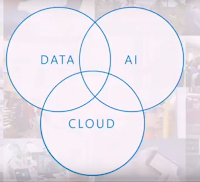
of cloud, data and AI. With that Microsoft have created an AI platform that is
fast and agile, with AI built in and enterprise proven for on-premises to edge
to create insights. The evolution of the data state takes into account increasing
data volumes, new data sources and types and open source languages. There are 3
stages between the heterogeneous sources and providing apps and insights.
- Ingest – data orchestration and monitoring
- Store – Data Lake and storages
- Machine learning – preparations and train ( Hadoop / spark / SQL and ML) then model and serve (on-prem, Cloud, IoT).
In
summary the 2 day conference provided great insight into many new technical areas
and raised thought provoking questions about the future of data and AI.
Sunday, 1 October 2017
Microsoft for the Modern Data Estate
The Microsoft Ignite
session on the modern data estate was full of announcements. All around us,
data is driving digital transformation. Modernize with SQL Server 2017 on Linux
and Windows and Azure Data Services; deliver modern intelligent applications
using technologies like Azure Cosmos DB and Azure Database for PostgreSQL.
The world is
changing. We need to help invest in the
future without being tied to the past. AI is a fundamental pillar to leverage that.
If businesses invests in data they outperform other companies.
Data doesn’t
need to leave the database for data science to take place.
The cloud first approach
breeds faster innovation and SQL Server 2017 is proof of that.
Announcements
SQL Server 2017
on Linux, Docker , and Windows server
Supports for
graph data and queries
Advances
Machine Learning with R & Python
Native T-SQL
scoring
Adaptive Query
processing and Automatic Plan Correction
Vulnerability
assessment for GDPR - preview
Intelligent
insights into performance – preview
Support for
Graph data and queries –GA
Adaptive query
processing – GA
Native scoring
and support for Azure Machine Learning - GA
SQL Database and Database Migration Service
Migration to the cloud is easy with this new service.
Azure SQL Database is the intelligent cloud database
for app developers. It learns and adapts, scales on the fly, enables multi-tenant SaaS apps, works in your environment, secures and protects. The systems of intelligence on SQL Database is shared.
Globally Distributed Applications
Announcing Azure
functions for Azure Cosmos DB to build apps faster with a serverless
infrastructure.
The new Azure Data Factory allows easy modelling of diverse data integration scenarios. You can
now with the preview service, easily move your SQL Server Integration Services
(SSIS) workloads to cloud. There is also a data movements as a service with
30+ connectors. Azure SQL Data Warehouse has a compute- optimized tier and unlimited
columnar storage in preview. The last announcement was the Power BI Report Server.
Saturday, 30 September 2017
Microsoft Ignite Vision Keynote
The 3 key technologies that will fundamentally transform our
industry are mixed reality, artificial intelligence and quantum computing.
There is a new computing paradigm on how to support and
transform apps that we build, that is AI first. This is changing the culture inside organizations. Microsoft are joining graphs to produce systems of
intelligence for sales, field service, customer service, talent and operations. To be one pervasive graph that is extensible. This will change the frontier about simplicity of tasks, unlocking new innovation and creativity, to create the next platform.
The aim is to democratize access to technology and to unlock
the unimaginable and solve the impossible, that is the quest we are on.
Tuesday, 26 September 2017
SQL Server 2017
Monday, 25 September 2017
Database Systems Guide to Best Practice
management of these database systems are a critical part to many organizations. In
addition the growth in the volume, variety and velocity of data has exacerbated the
need to have innovative ways to manage this data. The term best practices are
continually disseminated as the best way to manage these various configurations,
layers and dependencies.
This guide helps to demystify what are the key areas of best practice, to be
considered when managing database systems. The database system is explained
and best practice challenges identified. This guide reveals the working cogs of best
practice derived from the academic research before the revolutionary transformation
of best practice, with a 360-degree approach is shared.
The guide can be read here.
Data Story Telling
Story telling is an important facet when working with data. Whilst I was working on my research PhD I thought it was important to share the main stages of this work. My entire PhD storyboard is shared here.
Subscribe to:
Posts (Atom)


