Yesterday was my first AWS Summit at ICC London, ExCeL. The event was much larger than I thought. On arrival I had to queue for over 25 minutes to get into ICC London. Then had to queue again to collect the registration badge, then had to go to another room to be security checked. 45 minutes later managed to get a seat in the keynote which had already started.

There was a great demo showing robots working in a distribution centre at @OcadoTechnology using AI. The keynote raised the question of old world relational databases. Do we still need old world relational databases? They say not and MySQL, PostgreSQL and MariaDB are why customer are moving to Open database engines.
The Forces and market trends that are causing adoption of new services
- Amazon Aurora (a MySQL-compatible relation database engine that
combines the speed and availability of high-end commercial databases)
- Amazon Relational
Database Service (covers MySQL, Oracle, SQL Server, or PostgreSQL database in
the cloud)
- Amazon DynamoDB
(a highly scalable, fully managed NoSQL database service)
- Amazon Redshift
(a fully managed, easily scalable petabyte-scale data warehouse service that
works with your existing business intelligence tools)
- Amazon
ElastiCache (a web service that makes it easy to deploy, operate, and scale an
in-memory cache in the cloud.)
- AWS Database
Migration Service
Migrating Data to and from AWS
When migrating databases to AWS you can backup your SQLServer database and restore the backup file to AWS RDS or EC2. The migration steps
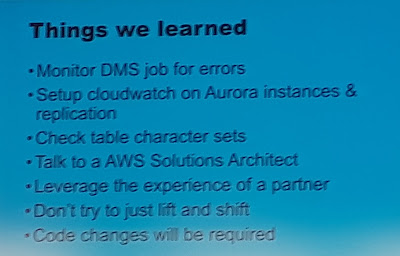
There were various things to learn from the migration.
The Amazon Relational Database Service (Amazon RDS) covers
Amazon Aurora keeps 6 copies of the data, two copies in each availability zone to protect against availability zone failure.
There are
various Analytics services such as
- Amazon Athena (is an interactive query service to analyze
data in Amazon S3 using standard SQL. Athena is serverless)
- AWS Data Pipeline (is a web service that helps you reliably
process and move data between different AWS compute and storage services, as
well as on-premise data sources, at specified intervals)
- AWS Glue (is a fully managed ETL service that makes it easy
to move data between your data stores)
- Amazon Kinesis (to collect, process, and analyse real-time
streaming data)
Artificial
Intelligence service offerings are:
- Amazon Lex
- Amazon Polly
- Amazon
Rekognition
- Amazon Machine
Learning
- AWS Deep
Learning AMIs
- Apache MXNet on
AWS
AWS was called the centre of gravity for AI.
Machine Learning capabilities explained


