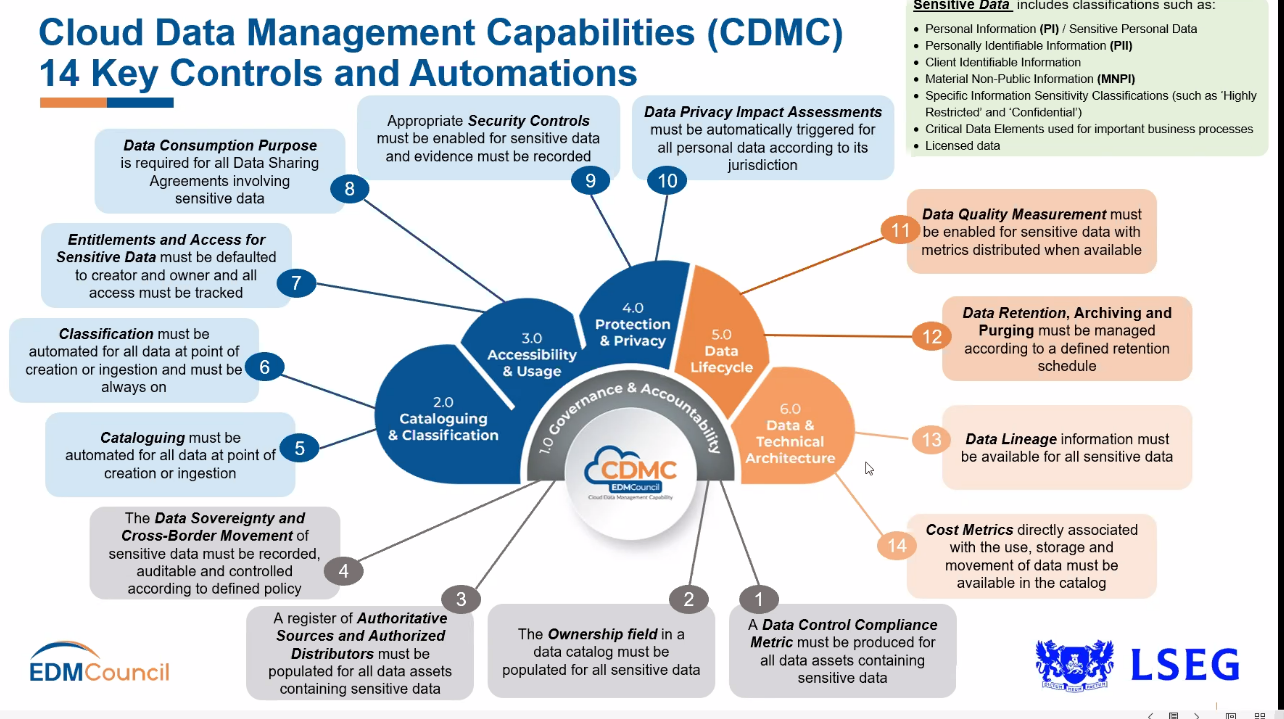
For years, data governance has relied on a familiar model: committees, policies, spreadsheets, and periodic reviews. It worked when data moved slowly, systems were predictable, and change could be managed through human oversight but that world no longer exists.
Today, data is created, transformed, and consumed continuously across cloud platforms. AI models are trained on that data in near real time. Decisions happen in milliseconds. And yet, in many organizations, governance is still anchored in manual controls and retrospective checks. There’s an uncomfortable truth emerging: human-in-the-loop governance cannot scale to cloud speed. The question is no longer whether governance is important. It’s whether governance can keep up and this is where the industry has been quietly converging on a new answer.
The EDM Council didn’t create the Cloud Data Management Capabilities (CDMC) framework to replace existing governance thinking. It created it because something was missing. Frameworks like DAMA-DMBOK remain foundational they define what good governance looks like across domains such as data quality, metadata, and security. But they were never designed for an environment where:
- Data is distributed across cloud services
- Access decisions are made dynamically via APIs
- Policies must be enforced continuously not reviewed quarterly
CDMC fills that gap. It translates governance intent into 14 concrete, measurable controls, designed specifically for cloud environments, with a clear emphasis on automation and continuous enforcement.
In other words, it moves governance from principle to execution.
From Policy to Enforcement: What Automation Really Means
The power of CDMC is not just that it defines controls, it defines controls that can be automated, monitored, and evidenced. This is a fundamental shift. Traditional governance asks: Do we have a policy? CDMC asks Is this control being executed automatically, right now, and can we prove it? Across its 14 controls spanning governance, classification, privacy, lifecycle, and architecture, CDMC embeds governance directly into the data pipeline itself.
The impact of that shift becomes most visible when you look at a few critical controls.
Control #1: Governance Accountability in an AI World
One of the simplest, yet most powerful, requirements is this: every sensitive data asset must have a defined owner. This is not new in principle. DAMA has long emphasised stewardship and accountability but CDMC enforces it through automation ensuring that ownership fields are populated in data catalogs, monitored, and escalated when missing. In an AI-driven context, this becomes critical. If a model produces biased or incorrect outputs, the question is no longer abstract. It becomes operational:
Who owns the data that trained this model?
Without automated ownership tracking, accountability collapses. With it, organizations can trace responsibility back to the source.
Control #11: Data Privacy that doesn’t rely on Humans
Privacy has always been a governance priority. But manual processes, reviews, sign-offs, compliance checklists are no longer sufficient when data is constantly moving and being repurposed. CDMC embeds privacy into the flow of data itself. It requires automated triggers, such as data protection impact assessments for personal data, ensuring that privacy controls are activated consistently and at scale. This matters even more in AI scenarios, where training datasets can be assembled from multiple sources rapidly. You simply cannot rely on someone remembering to remove PII before it enters a pipeline. You need a system that ensures it never gets there in the first place.
Control #12: Stopping Data Swamps before they start
Data quality has always been a known challenge. What’s changed is the speed at which poor-quality data propagates. In traditional environments, issues might take weeks to surface. In AI pipelines, they surface instantly and at scale. CDMC addresses this by requiring data quality measurement as a built-in control, applied at ingestion and continuously monitored through metrics. This is a subtle but profound shift. Instead of discovering problems downstream, organizations prevent them upstream. Instead of cleaning data after the fact, they stop poor data from entering the ecosystem at all. This is how you avoid the modern equivalent of a data warehouse problem: the AI-era data swamp.
.png)
The joined-up Framework: DAMA as Constitution, CDMC as Enforcement
It’s tempting to position CDMC as a replacement for traditional frameworks but that misses the point. The real strength comes from how they work together.
- DAMA-DMBOK defines the principles of governance, the constitution that outlines what good looks like
- CDMC defines the execution, the enforcement layer that ensures those principles are actually applied
Where DAMA says:
Data must be secure.
CDMC operationalises it as:
Security controls must be enabled, monitored, and evidenced automatically for all sensitive data.
Where DAMA defines accountability, CDMC ensures accountability exists in the system. Where DAMA defines quality, CDMC ensures quality is measured continuously. This is the bridge many organizations have been missing.
From Governance Theatre to Operational Reality
There is a growing gap between organizations that talk about governance and those that have embedded it into their platforms.
Manual governance processes, however well designed, become governance theatre in cloud environments:
- Policies exist, but are not enforced
- Ownership is defined, but not maintained
- Controls are documented, but not executed
CDMC changes the conversation. It forces organisations to move from:
- Periodic assurance → continuous control
- Documentation → instrumentation
- Manual oversight → automated guardrails
And that’s what makes it so relevant in the age of AI.
AI doesn’t remove the need for governance, it increases it exponentially. But it also exposes the limits of traditional approaches. You cannot govern at cloud speed with spreadsheets, committees, and retrospective checks. You need governance that is:
- Embedded
- Automated
- Measurable
- Continuous
That’s the shift CDMC represents. Not a new theory of governance but a new way of making governance real.
References