Welcome

Passionately curious about Data, Databases and Systems Complexity. Data is ubiquitous, the database universe is dichotomous (structured and unstructured), expanding and complex. Find my Database Research at SQLToolkit.co.uk . Microsoft Data Platform MVP

"The important thing is not to stop questioning. Curiosity has its own reason for existing" Einstein


Showing posts with label SQL Server 2016. Show all posts

Tuesday, 11 April 2017

State of the SQL Nation and the Microsoft Engineering Model


SQLBits 2017 was different this year and instead of a keynote launching the event they had a 15 mins Q & A session with Conor Cunningham and Simon Sabin. They discussed the rapid change of new engineering features in the product. There are now new features shipped monthly. The new model requires running test 24/7 and the interesting change is that all builds have the same level of sign off, increasing the quality of the build now. This is why the quality of the 2 monthly cumulative updates has increased. They run over 700,000 functional automated tests and stress test as well. They aim to ship with the minimum viable product and release updates every 3 to 6 months on them. They don’t deprecate features specifically unless there is a security risk and they use telemetry to help measure feature adoption.

SQL Server / Azure Engineering Model

A second session I attended was about the completely new engineering model that Microsoft now operate. There were some very interesting changes that I think all businesses need to think about when designing and structuring new teams to adapt to the changing model.

Microsoft DevOps Interesting Facts

  • Microsoft have around 1.7 million production databases.
  • They have no Database Administrators (DBAs).
  • They have no Operations team.
  • Engineers automate everything.
  • SQL Server Azure runs 100% DevOps.
  • SQL Server is managed by telemetry. 600TB of logs are collected every day and machine learning algorithms used to automatically fix, migrate and manage the systems.  They have a large big data pipeline to process the logs in various ways.

 Privacy Statement
The SQL Server Privacy Statement has been updated. It explains the data collection and use practices for Microsoft SQL Server 2016 (SQL Server) and included or referenced products which can be installed separately (such as SQL Server Management Studio). This is a huge change with Microsoft stating explicitly what data they store.  It explicitly provides a data classification matrix for access control, customer content, end-user identifiable information (EUII) , internet based services data and system metadata and explains permitted usage scenarios, access restrictions and retention requirements. This will massively help with regulatory and compliance requirements for the up and coming GDPR. You can now OPT IN and OPT OUT.


Compliance Boundary Around the Service
The way for security is using more automated ways to protect systems. Microsoft use

  • Two factor authentication to cross boundary to administrator / troubleshoot  
  •  All access is audited
  • Customer data is protected in the boundary
  • Telemetry is used to protect data
  • Telemetry is scrubbed to protect customer data
  •  The disks are encrypted

SQL Server vNext

SQL Server vNext is to be shipped later this yearWe can expect to see the SQL Server products to have more frequent releases than the previous every 2 to 3 years.

Another big change in Microsoft development is for all SQL product features is that they need to have customers asking for them. This sounds like a more relevant model.

The vNext version of SQL Server will have important new features such as being able to

  • SQL Server on Linux
  • Linux based Docker containers
  • SQLGraph
  • Cluster-less Availability Groups
  • Availability Groups can now work across Windows-Linux to enable cross-OS migrations
  • Online non-clustered columnstore index build and rebuild
  • Temporal Tables Retention Policy support

 SQL Azure Cloud Service is similar but not quite the same as the SQL Server product.  


Thursday, 5 January 2017

DBMS of the Year

SQL Server is the DBMS of the Year.
http://db-engines.com/en/blog_post/67

DB-Engines.com write "Microsoft SQL Server is the database management system that gained more popularity in our DB-Engines Ranking within the last year than any of the other 315 monitored systems. We thus declare Microsoft SQL Server as the DBMS of the Year 2016"

Wednesday, 16 November 2016

SQL Server 2016 Service Pack 1

SQL Server 2016 SP1 is released with key innovations accessible across all SQL Server editions. Microsoft want to make it easier for developers and partners to build and upgrade applications that take advantage of advanced performance, security, and data mart capabilities. Full details are here http://bit.ly/2eH8VGJ  

Features now available in all versions


The Future of Database Management

There is a change coming to the database administration role. Change brings uncertainty but it also brings opportunity.  The database administration role has not really changed for a decade and although change is now a foot it will be a several years before the full force of the cloud is fully embedded in the database world.  These are exciting times for database administrators.  


The new offerings from Microsoft span the entire breath from Physical to Platform as a Service.


Some offerings will always stay on physical machines while I suspect the majority will move to Platform as a Service just in the same way as physical server offerings moved to virtualization platforms a few years ago.

In my opinion, the role of the administrator will not be lost. It is after all an administration role and just because some of the database services move to Platform as a Service, administrative tasks still need to be undertaken. The complexity of database management will just transition to a new level.

Moving to the Microsoft cloud offerings there are two to consider. Infrastructure as a Service, SQL Server in a VM and Azure SQL Database. SQL Server in a VM is currently a VM that is still fully managed by individual businesses. There is the opportunity to select additional options to help lighten the load as an administrator. By using the SQL Server Iaas Agent extension, it is possible to delegate the automatic backup and patching to Microsoft.  These, although a critical part of the service, can be advantageous allowing DBAs to spend more time working on performance tuning, creating and testing those run books and data. These offerings are very likely to be the option of choice for many years due to the historic nature of applications and businesses needing to stay on versions of SQL Server that are supported by the applications that use them. Businesses need to be able to use support contracts with providers when product issues occur and that requires being on their supported configurations.

Azure SQL Database is an entirely different option. It is a Platform as a Service. Microsoft takes care of patching, backups, monitoring, high availability and security. The SQL database advisor provides help with performance tuning. This is an inclusive database service which will work well for new applications. There always seem to be a lot of smaller or less active databases that just take up valuable time and would suit this approach well. The administration cost of databases is very high for businesses, particularly as data is a key part of every business, and this service will enable business to better manage their services without having the dedicated need of an administrator.

There is another option which is now appearing which may affect development environments and that is the use of Docker images for SQL Server. Windows containers are isolated resource controlled environments and an application can run without affecting the rest of the system. This solution is likely to benefit the continuous deployment process and rapid test scenarios.  

I believe the future of administration is architecting the most suitable database solution and recommending the tools to use. Also, through DevOps, creating deployment scripts which will need to be continually written and updated, working on performance tuning of database code and data security administration. The other key change I see is the diversification of knowledge and gaining of skills through all the peripheral data tools which now need managing.  


Enhancing Business Intelligence with Data Science

The heterogeneous nature of data has resulted in an evolution of the business intelligence platform. The traditional data warehouse architectures are now a part of a greater diverse set of products and tools available for use, to gain insight. This new architecture is in Microsoft Azure, which consists of information management, big data stores, machine learning and analytics and intelligence.


This huge number of tools are known as the Cortana Intelligence Suite. Cortana Intelligence is a platform and a process to perform advanced analytics from start to finish. It is a fully managed business intelligence, big data and advanced analytics offerings. Microsoft have been helping people learn the 14 new tools to explain and show how these fit together by using a mnemonic.

Say it Cortana, Cognitive Services, Bot Framework – intelligent assistant for speech and vision
See it Power BI – interactive report and visualization
Stream it Azure Stream Analytics – real time stream processing
Big it HD Insight – implementation of apache Hadoop
Learn it Azure Machine Learning and MRS – machine learning and R Server engine
Relate it Azure SQL DB, Data Warehouse, DocumentDB -  SQL and NoSQL engines
Store it Azure Data Lake –data storage and distributed processing
Bring it Azure Event Hubs – ingest data for web, IoT and apps
Move it Azure Data Factory – pipeline to move data in and out
Doc it Azure Data Catalog – documentation
Host it Microsoft Azure - IaaS, PaaS or SaaS

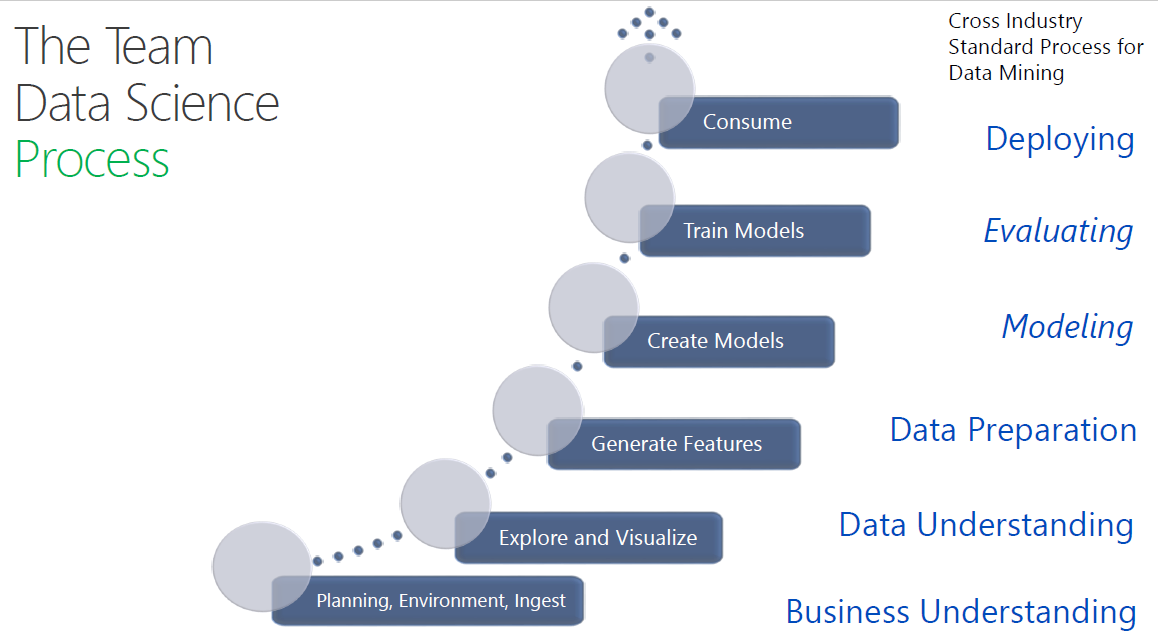
These tools are supplemented by a modified process model based on the CRISP-DM (Cross Industry Standard Process for Data Mining). CRISP-DM is a data mining process model that describes commonly used approaches that data mining experts use to tackle problems. CRISP-DM has six major phases. 

The Microsoft team science process is:


There are many tools to get started learning about data science and these a just a few.

A collection of data science tools

Code samples

Free eBooks from Microsoft Press - Microsoft Virtual Academy
  • Data Science with Microsoft SQL Server 2016
  • Microsoft Azure Essentials: Fundamentals of Azure, Second Edition

Data science track in the Microsoft Professional Program
https://academy.microsoft.com/en-us/professional-program/data-science/

Wednesday, 1 June 2016

The Wait is Over: SQL Server 2016 General Availability and Tools


SQL Server 2016 is generally available today. The release blog provides more details. The full featured Developer Edition is free. This can be downloaded
  
The generally available release of SQL Server Management Studio (SSMS) is annouced today. It provides a means for accessing, configuring, managing, administering, and developing all components of SQL Server. SSMS combines a broad group of graphical tools with a number of rich script editor. It features improved compatibility with previous versions of SQL Server, a stand-alone web installer, and toast notifications within SSMS when new releases become available.

The SQL Server 2016 RTM build is 13.0.1601.5. SSMS 2016 has a build number of 13.0.15000.23.

SQL Server Data Tools (SSDT) for Visual Studio 2015 is now generally available.

SSDT can be  downloaded for free to build SQL Server relational databases, Azure SQL databases, Integration Services packages, Analysis Services data models, and Reporting Services reports.

The SQL Server 2016 free e-book can be downloaded. It  covers

  • Mission-Critical Performance: Chapters cover faster queries, better security, higher availability, and the improved database engine.
  • Deeper Insights Across Data: Chapters cover the broader data access, increased analytics, and better reporting in SQL Server 2016.
  • Hyperscale Cloud: Chapters cover the improvements in Azure SQL Database and how to expand your options with SQL Data Warehouse.

Tuesday, 31 May 2016

New Sample Database: Wide World Importers


Microsoft have replaced the the Adventure Works Sample Databases. There was Pubs, then Adventures Works and now Wide World Importers. Wide World Importers is a sample database that both illustrates database design, and how SQL Server and Azure SQL Database features can be leveraged in an application.

The sample database represents a typical database. The Wide World Importers database can be used for  transaction processing (OLTP - Online Transaction Processing) and operational analytics (HTAP - Hybrid Transaction and Analytics Processing). There are sample queries, processes for ETL (Extract, Transform, Load) that migrates data from the transactional database WideWorldImporters to the data warehouse WideWorldImportersDW and descriptions that show how to leverage SQL Server features for analytics processing.

Applies to: SQL Server 2016 (or higher), Azure SQL Database
Features including: Core database features, PolyBase, nonclustered columnstore index, Row-Level Security
Workload types: OLTP, OLAP, IoT, Analytics, Operational Analytics
Programming Language: T-SQL, C#

Sunday, 8 May 2016

SQLBits in Space


SQLBits XV was held between 4 -6 May 2016 at the Exhibition Centre in Liverpool. It was the official UK launch event of SQL Server 2016 which will RTM 1st June. There were lots of amazing sessions held for the first time in domes.

The keynote was delivered by Joseph Sirosh, the corporate vice president of the Microsoft Data Group. His keynote entitled the unreasonable effectiveness of data. A paper was written by Alon Halevy, Peter Norvig, and Fernando Pereira of the same titleJoseph Sirosh mentioned the future effectiveness of data and the Sloan Digital Sky Survey, the 1st astronomy datascope. A take away was that there are many new data services and R should be the language to learn. 

There were many sessions covering the new features of SQL Server 2016 on both the BI and administration side. A highlight for me was the training day on data science by Buck Woody and using the Cortana Intelligence suite. 

The Cortana Analytics Suite big data and advances analytics process


The Azure IaaS and PaaS Services are embedded into these services.


U-SQL is another new language that allows you to query unstructured data. Michale Rys delivered a very informative session on Azure Data Lake and U-SQL. The traditional data warehousing approach is

  The new Data Lake approach


 The slides are http://www.slideshare.net/MichaelRys

 There are many new features in SQL Server 2016 and many new data features in Azure.

Monday, 2 May 2016

SQL Server 2016 General Availability


SQL Server 2016 will be generally available on 1st June 2016. The SQL Server 2016 editions will include Enterprise, Standard, Express, and Developer.  SQL Server 2016 Developer edition will be free to download.

The SQL Server 2016 preview details .

Wednesday, 6 April 2016

Thursday, 10 March 2016

SQL Server 2016 Rocks


The SQL Server Data Driven event shared the forthcoming toolset to enable business transformation with data.


The directors of tomorrow will embrace technology to become leaders across industries. If you want to disrupt, you must adopt and adapt to new technology. Data is the connective tissue driving all technological revolution. Data assets are core to the success of a business.  It enables business to engage better with customers to transform products and services
 
T-SQL and R will be in one place for real time predictive analytics  and it is possible to extend databases into the cloud to allow customers to keep information they don't have local storage space for.  
        
SQL Server 2016 is always encrypted even when processing is being done and even if the in-memory engine being used, using homomorphic encryption.
 
SQL Server 2016 is a true data platform not just a database with mission critical intelligence which is what distinguishes it from all others.  SQL Server 2016 is key to business transformation. Intelligence driven from data is now enabling new ways of working.  
     
 
Data is at the heart of transformation enabling engagement with Customers, Running your Business and Transforming your Products.
 
 
Microsoft have created significant incentives to encourage people with Oracle databases to migrate to SQL Server.
 
 
You can run SQL Server 2016 in a docker container and also on Linux.

Wednesday, 9 March 2016

Announcing SQL Server on Linux

Microsoft have announced SQL Server on Linux to make their data solutions more flexible. The target date for availability is mid-2017.

More details
https://blogs.microsoft.com/blog/2016/03/07/announcing-sql-server-on-linux/

Monday, 7 March 2016

SQL Server 2016 release candidate

The rapid release model for SQL Server 2016 means Microsoft will be publishing multiple release candidates.

Product enhacements include

  • Stretch Database service
  • Enhancements to In-Memory OLTP
  • Enhancements to SQL Server Analysis Services
  • Enhancements to SQL Server Reporting Services

The SQL Server evaluation can be downloaded from https://www.microsoft.com/en-gb/evalcenter/evaluate-sql-server-2016

Friday, 19 February 2016

SQL Server 2016 Live Event


The SQL Server 2016 Data Driven Event is here

The event will discuss data transformation 

  • how data insights are driving business transformation
  • how customers are embracing data to drive innovation
  • why SQL Server 2016 has become the industry leader


The SQL Server 2016 Datasheet details the new features.

Useful papers to read: 

Mission Critical white paper
In-memory OLTP technical paper
In-memory OLTP and ColumnstoreFeature Comparision
Deeper data insights
 

Tuesday, 12 January 2016

Free ebook: Introducing Microsoft SQL Server 2016

There is a new free ebook Introducing Microsoft SQL Server 2016: Mission-Critical Applications, Deeper Insights, Hyperscale Cloud, Preview Edition.

The chapters released so far are

Better Security
Improved database engine
Better reporting

Sunday, 6 December 2015

SQL Server in the Cloud Options


There are many SQL Server choices available to us as database architects. This diagram shows the Microsoft database stack available choices and the business drivers that affect the choice of cost versus administrative overhead.


An article SQL Server in Azure: Compare PaaS (SQLDB) andIaaS (Virtual Machine)
explains in more depth about the cloud options of SQL Server in Azure (IaaS) and Azure SQL Database. Igor Pagliai included this useful table.


Topic
Azure
  SQLDB (PaaS)
SQL
  Server VM (IaaS)
Features Less features than box Full box product features

Performances Max 1750 DTU in Premium Tier Depends on VM SKU/Storage

DB Size Max 1TB in Premium Tier (P11) 64TB on G-SERIES
Workload Sizing by average usage Sizing based on peaks
High-Availability Built-in by platform   

Manual configuration by AlwaysOn AG
Fault-Handling Necessary fault-handling &
  retry
Recommended fault-handling &
  retry
Locality No co-location with application Co-located by VMs and VNETs
Segregation Internet exposed endpoint

Internal private endpoint

Versioning No control on upgrades 

Full control over DB upgrade
TCO Very low, almost self-managed     High (as on-premise)    

Administration No full-time DBA required       Full staffed DBA required

Management Easy to manage many DBs

Complex to manage many DBs/VMs
Scale-Out Tools & Frameworks available No easy scale-out       

Configuration No setup customization 

Full access to OS and SQL

Authentication Only SQL standard authentication SQL standard and integrated

Security No Fixed IP available  

Fixed IP possible at VM level
Backup Backup files not accessible Full control of backup files