Came across these excellant 2 diagrams from 2 very interesting blog posts.
“NewSQL-as-a-Service” Cloud Database
This diagram shows where all the main database engines fit into the wider data management landscape. Taken from http://xeround.com/blog/2011/04/newsql-cloud-database-as-a-service although the original article NoSQL, NewSQL and Beyond: The answer to SPRAINed relational databases is by Matthew Aslett which is part of the The 451 Group’s new long format report on emerging database alternatives, NoSQL, NewSQL and Beyond.
http://blogs.the451group.com/information_management/2011/04/15/nosql-newsql-and-beyond
Don’t Become a One-trick Architect
This article by Thomas Kejzer gives an historical look at architectures and data http://blog.kejser.org/2011/12/08/dont-become-a-one-trick-architect/#more-377
This is the evolutionary tree of life for data storage engines
Chaos, complexity, curiosity and database systems. A place where research meets industry
Welcome
Passionately curious about Data, Databases and Systems Complexity. Data is ubiquitous, the database universe is dichotomous (structured and unstructured), expanding and complex. Find my Database Research at SQLToolkit.co.uk . Microsoft Data Platform MVP
"The important thing is not to stop questioning. Curiosity has its own reason for existing" Einstein
Monday, 23 July 2012
Saturday, 21 July 2012
SQL Server 2012 Install by Configuration File
Automating a SQL Server installation for unattended installation creates a consistent deliverable for a SQL Server build.
To create the configuration file run through the GUI installation selecting your predefined defaults and prior to clicking Install collect the configuration file from the specified path listed on the Ready to Install page e.g. C:\Program Files\Microsoft SQL Server\110\Setup Bootstrap\Log\20120619_140314\ConfigurationFile.ini
The configuration file will need additional configuration details for unattended use as sensitive information is not included.
A few parameter may need updating between server builds.
Security
The other sensitive information which is not written to the configuration file are the passwords. These can be passed into the installation configuration at run time using
Setup.exe /SQLSVCPASSWORD="************" /AGTSVCPASSWORD="************" /ISSVCPASSWORD="************" /SAPWD="************"
/ConfigurationFile=DefaultConfigurationFile.INI
The Service and SQL account parameters are:
SQLSVCPASSWORD: Account for SQL Server service: Domain\User
AGTSVCPASSWORD: Agent account name: Domain\User
ISSVCPASSWORD: Account for Integration Services: Domain\User
RSSVCPASSWORD: Account for Reporting Services: Domain\User
ASSVCPASSWORD: Account for Analysis Services: Domain\User
SAPWD: Specifies the password for the SQL Server sa account.
The Microsoft article that describes the install of SQL Server 2012 using a configuration file can be found here http://msdn.microsoft.com/en-us/library/dd239405.aspx. A full list of parameters are stated here http://technet.microsoft.com/en-us/library/ms144259
To create the configuration file run through the GUI installation selecting your predefined defaults and prior to clicking Install collect the configuration file from the specified path listed on the Ready to Install page e.g. C:\Program Files\Microsoft SQL Server\110\Setup Bootstrap\Log\20120619_140314\ConfigurationFile.ini
The configuration file will need additional configuration details for unattended use as sensitive information is not included.
- IACCEPTSQLSERVERLICENSETERMS is required to acknowledge acceptance of the license terms.
- The QUIET and QUIETSIMPLE settings are required to allow the Setup to display progress only, without any user interaction.
A few parameter may need updating between server builds.
Security
The other sensitive information which is not written to the configuration file are the passwords. These can be passed into the installation configuration at run time using
Setup.exe /SQLSVCPASSWORD="************" /AGTSVCPASSWORD="************" /ISSVCPASSWORD="************" /SAPWD="************"
/ConfigurationFile=DefaultConfigurationFile.INI
The Service and SQL account parameters are:
SQLSVCPASSWORD: Account for SQL Server service: Domain\User
AGTSVCPASSWORD: Agent account name: Domain\User
ISSVCPASSWORD: Account for Integration Services: Domain\User
RSSVCPASSWORD: Account for Reporting Services: Domain\User
ASSVCPASSWORD: Account for Analysis Services: Domain\User
SAPWD: Specifies the password for the SQL Server sa account.
The Microsoft article that describes the install of SQL Server 2012 using a configuration file can be found here http://msdn.microsoft.com/en-us/library/dd239405.aspx. A full list of parameters are stated here http://technet.microsoft.com/en-us/library/ms144259
Sunday, 1 July 2012
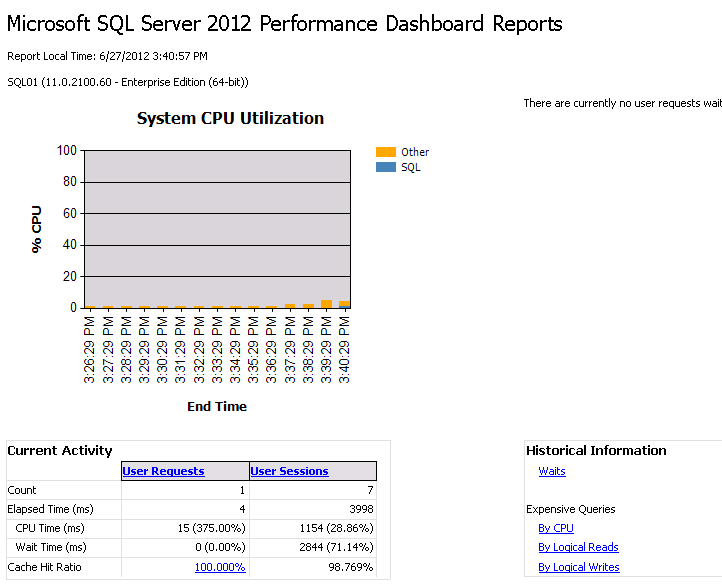
Performance Dashboard Reports
The new custom Performance Dashboard Reports for SQL Server 2012 can be obtained from http://www.microsoft.com/en-gb/download/details.aspx?id=29063
As with the earlier versions of these reports they allow a database administrator to quickly identify whether there is a current bottleneck on the system, and capture additional diagnostic data that can help resolve some common problems such as:
There are 3 parts to the deployment process.
As with the earlier versions of these reports they allow a database administrator to quickly identify whether there is a current bottleneck on the system, and capture additional diagnostic data that can help resolve some common problems such as:
- Common performance problems that can be indeitifed through the dashboard are CPU bottlenecks (and what queries are consuming the most CPU)
- IO bottlenecks (and what queries are performing the most IO)
- Index recommendations generated by the query optimizer (missing indexes)
- Blocking
- Latch contention
There are 3 parts to the deployment process.
- Run the run installer. The dashboard automatic install path places the files in C:\Program Files (x86)\Microsoft SQL Server\110\Tools\Performance Dashboard.
- In the Performance Dashboard folder execute the setup.sql script.
- Test the deployment by opening a report. Open the report by selecting the server instance in SQL Server Maangement Studio (SSMS) and in the menu options select Reports, then; Custom reports and navigate to the install path C:\Program Files\Microsoft SQL Server\110\Tools\Performance Dashboard. Then select performance_dashboard_main.rdl and Click open and select Run.
Wednesday, 20 June 2012
The Dichotomy of Database Models
There has been significant debate on ACID and BASE and which is the way forward. A summary of the two models is described here.
ACID model
The relational database model for transactions are based on ACID properties, the term coined by Haerder & Reuter in 1983. This guarantees reliability, consistency and recoverability. It has four properties:
Atomicity
It is an ‘all or nothing’ approach. The transaction is performed in its entirety or not performed at all. Therefore if any part of the transaction fails it all fails and no change is made.
Consistency
The database transforms from one consistent state to another consistent state. The database cannot be left in an inconsistent state.
Isolation
Transactions execute independently of each other. This ensures that even if concurrent executions of transactions happen they are left in a state as if the transactions have executed serially. Partial and incomplete transactions should not be visible to other transactions.
Durability
Successful completed transactions are committed into the database and stored permanently. They persist after restarts.
New Patterns – CAP theorem
The concepts and patterns discussed in the paper ‘NoSQL Databases’ by Christof Strauch demonstrates the new concept to reduce complexity. The CAP-theorem was coined by Eric Brewer in 2000. It has three guarantees:
Consistency
The data is correct all of the time after the execution of an operation. A distributed system is typically considered to be consistent if, after an update operation, all readers see the updates in a shared data source.
Availability
It guarantees that data can be read and written all the time due to the architectural design and implementation.
Partition Tolerance
The system has the ability to continue to operate in the presence of a failure of part of the system.
BASE model
The concepts of NoSQL datastores use the BASE pattern. “The BASE approach according to Brewer forfeits the ACID properties of consistency and isolation in favour of “availability, graceful degradation, and performance” Strauch.
The acronym BASE is composed of the following characteristics:
Basic Availability
It uses replication techniques to reduce data unavailably. It is highly distributed and uses sharding and partitioning of data within its storage model.
Soft State
This allows data to be inconsistent and assumes that it is managed by the developer and not the database.
Eventual Consistency
At some point in the future the data will reach a consistent state. It is unknown when that will happen.
Brewer contrasts ACID with BASE Design Patterns considering the two concepts as a complementing spectrum.
In conclusion we have two complementary design patterns for a universe where both structured and unstructured data reside.
ACID model
The relational database model for transactions are based on ACID properties, the term coined by Haerder & Reuter in 1983. This guarantees reliability, consistency and recoverability. It has four properties:
Atomicity
It is an ‘all or nothing’ approach. The transaction is performed in its entirety or not performed at all. Therefore if any part of the transaction fails it all fails and no change is made.
Consistency
The database transforms from one consistent state to another consistent state. The database cannot be left in an inconsistent state.
Isolation
Transactions execute independently of each other. This ensures that even if concurrent executions of transactions happen they are left in a state as if the transactions have executed serially. Partial and incomplete transactions should not be visible to other transactions.
Durability
Successful completed transactions are committed into the database and stored permanently. They persist after restarts.
New Patterns – CAP theorem
The concepts and patterns discussed in the paper ‘NoSQL Databases’ by Christof Strauch demonstrates the new concept to reduce complexity. The CAP-theorem was coined by Eric Brewer in 2000. It has three guarantees:
Consistency
The data is correct all of the time after the execution of an operation. A distributed system is typically considered to be consistent if, after an update operation, all readers see the updates in a shared data source.
Availability
It guarantees that data can be read and written all the time due to the architectural design and implementation.
Partition Tolerance
The system has the ability to continue to operate in the presence of a failure of part of the system.
BASE model
The concepts of NoSQL datastores use the BASE pattern. “The BASE approach according to Brewer forfeits the ACID properties of consistency and isolation in favour of “availability, graceful degradation, and performance” Strauch.
The acronym BASE is composed of the following characteristics:
Basic Availability
It uses replication techniques to reduce data unavailably. It is highly distributed and uses sharding and partitioning of data within its storage model.
Soft State
This allows data to be inconsistent and assumes that it is managed by the developer and not the database.
Eventual Consistency
At some point in the future the data will reach a consistent state. It is unknown when that will happen.
Brewer contrasts ACID with BASE Design Patterns considering the two concepts as a complementing spectrum.
| NoSQL Databases article page 32 by Christof Strauch |
Friday, 1 June 2012
Cube Synchronisation Scale Out Methods
There are 4 Analysis Services Synchronisation Methods
http://sqlcat.com/sqlcat/b/technicalnotes/archive/2008/03/16/analysis-services-synchronization-best-practices.aspx
Synchronize Analysis Services Databases
http://msdn.microsoft.com/en-us/library/ms174928.aspx
Other useful articles for scaling out Analysis Services are
REAL PRACTICES: Performance Scaling Microsoft SQL Server 2008 Analysis Services at Microsoft adCenter
http://sqlcat.com/sqlcat/b/whitepapers/archive/2011/03/14/real-practices-performance-scaling-microsoft-sql-server-2008-analysis-services-at-microsoft-adcenter.aspx
Scale-Out Querying with Analysis Services
http://sqlcat.com/sqlcat/b/whitepapers/archive/2007/12/16/scale-out-querying-with-analysis-services.aspx (download white paper http://technet.microsoft.com/library/Cc966449 )
Analysis Services 2008 R2 Performance Guide
Includes
Design Patterns for Scalable Cubes
Tuning Query Performance
Tuning Processing Performance
Special Considerations
http://sqlcat.com/sqlcat/b/whitepapers/archive/2011/10/10/analysis-services-2008-r2-performance-guide.aspx
- Analysis Services Synch Method
- Backup/Restore Database
- Attach/Detach Database
- Robocopy Method
http://sqlcat.com/sqlcat/b/technicalnotes/archive/2008/03/16/analysis-services-synchronization-best-practices.aspx
Synchronize Analysis Services Databases
http://msdn.microsoft.com/en-us/library/ms174928.aspx
Other useful articles for scaling out Analysis Services are
REAL PRACTICES: Performance Scaling Microsoft SQL Server 2008 Analysis Services at Microsoft adCenter
http://sqlcat.com/sqlcat/b/whitepapers/archive/2011/03/14/real-practices-performance-scaling-microsoft-sql-server-2008-analysis-services-at-microsoft-adcenter.aspx
Scale-Out Querying with Analysis Services
http://sqlcat.com/sqlcat/b/whitepapers/archive/2007/12/16/scale-out-querying-with-analysis-services.aspx (download white paper http://technet.microsoft.com/library/Cc966449 )
Analysis Services 2008 R2 Performance Guide
Includes
Design Patterns for Scalable Cubes
Tuning Query Performance
Tuning Processing Performance
Special Considerations
http://sqlcat.com/sqlcat/b/whitepapers/archive/2011/10/10/analysis-services-2008-r2-performance-guide.aspx
Monday, 28 May 2012
Database Conference Wish List
Database conferences are the place to share ideas and learn new technology. They are the place to expand ones database horizons and dream. My wish list for conference attendance would have to be
Professional Conferences
SQLBits
UK Location
http://sqlbits.com/
Probably End September 2012
SQLRally Nordic
Copenhagen
http://www.sqlpass.org/sqlrally/2012/nordic/
October 1-3 2012
SQL Pass Summit
Seattle, WA
http://www.sqlpass.org/summit/2012/
November 6-9 2012
Research Conferences
To explore cutting edge ideas in the database world.
ICDE 29th IEEE International Conference on Data Engineering
Brisbane, Australia
http://www.icde2013.org/
April 8-11 2013
2013 ACM SIGMOD/PODS
New York, USA
http://www.sigmod.org/2013/
June 22-27, 2013
39th International Conference on Very Large Data Bases
Rive del Garda, Trento
http://vldb.org/2013/
August 26-31, 2013
Data Conferences
Data and information management.
Enterprise Data World 2012
Atlanta, Georgia
http://edw2012.wilshireconferences.com/index.cfm
April 29 - 3 May 2012
Thursday, 24 May 2012
SQL Relay
I attended SQL Relay 2012 in Clifton, Bristol yesterday which brought together SQL experts from the southwest. The location was fantastic at the Avon Gorge Hotel which overlooks Brunel’s suspension bridge. The al fresco dining for lunch in the glorious Sun added to the interesting SQL discussions.
There were overview sessions from Microsoft in the morning on SQL Server 2012 and Deep Dive sessions in the afternoon from SQL Server MVP's.
The morning sessions delivered by Microsoft by Morris Novello, SQL Server Product Manager and Andrew Fryer, Technical Evangelist discussed the explosion of data volumes, new innovations in the cloud and new development features within SQL Server 2012. The practical overview of SQL Server 2012 new features showed the breadth and depth of the changes to the product which will take SQL Server to a new level.
The afternoon MVP’s Tony Rogerson covered SANless high availability with Always On and Martin Bell covered Distributed Replay. Considering disk geometry added an interesting dimension to Always On and being able to mitigate risk against hardware consolidation and changes using distributed replay was insightful.
Subscribe to:
Posts (Atom)